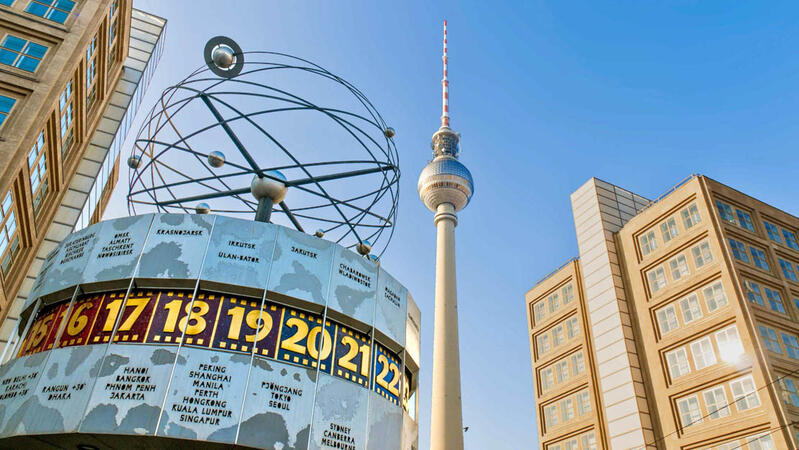
NobleProg delivers high-quality Computer Vision training courses in Berlin, the dynamic heart of Germany's tech and innovation sector. Participants benefit from expert-led instruction tailored to the professional needs of the capital's diverse industry landscape. Join our Berlin-based programs to enhance your skills with hands-on learning experiences in a world-class urban environment.
Whether delivered online or on-site, our instructor-led live Computer Vision training courses engage participants through interactive discussions and practical exercises. This approach allows learners to explore the fundamentals of Computer Vision by progressively building and testing simple Computer Vision applications.
Computer Vision training is offered as either "online live training" or "onsite live training". Online live training (also referred to as "remote live training") is conducted via an interactive remote desktop. Onsite live training can be held locally at customer facilities in Berlin or at NobleProg's corporate training centers in Berlin.
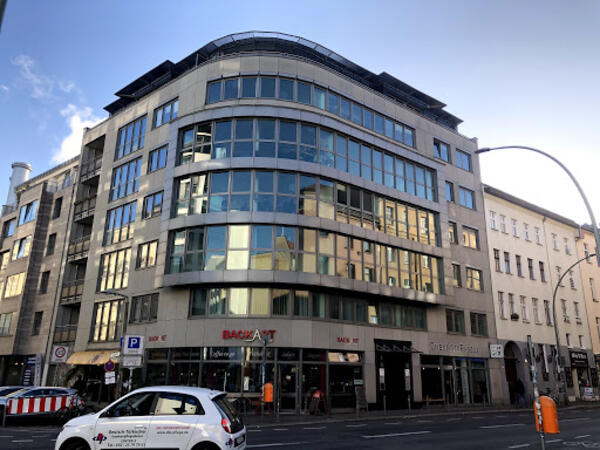
Our training facilities are located at Brückenstr. 4 in Berlin. Located on the fourth floor of a well-kept office building, our premises offer enough space for successful training courses in the heart of Berlin, within walking distance of the Jannowitzbrücke station.
Directions
The NobleProg training facilities are located in the heart of Berlin's Mitte district, just one underground station from Alexanderplatz, one of the centres of this vibrant city. By public transport you can reach us either by underground line U8 to Jannowitzbrücke station, followed by about 100 meters on foot.
Parking
Cars can be parked in the area along Brückenstr. and the nearby side streets, even if you may have to search for a moment. There is no charge for parking.
Local Amenities
Around the Rosenthaler Platz there are numerous small restaurants and shops where you can eat well and cheaply. There are also some hotels close by if you need accommodation for the training.
Our training facilities are located at Dianastrasse 46 in Potsdam-Babelsberg.
Our spacious training rooms are located directly opposite the Filmstudios Babelsberg and offer optimal training conditions for your needs.
Arrival
The NobleProg training facilities are conveniently located near the Medienstadt Babelsberg railway station,
and the A115 motorway is also easily accessible.
Parking
Parking is available in the surrounding streets around our training rooms.
Local Services
Potsdam offers numerous hotels and restaurants and is easily accessible thanks to its well-developed public transport system.
Tailored for intermediate to advanced computer vision engineers, AI developers, and IoT professionals, this instructor-led live training (delivered online or onsite) covers the implementation and optimization of computer vision models for real-time processing on edge devices.
By the end of this session, participants will have the capability to:
Understand the foundational aspects of Edge AI and its relevance to computer vision.
Deploy optimized deep learning models on edge hardware for real-time image and video analysis.
Utilize key frameworks such as TensorFlow Lite, OpenVINO, and NVIDIA Jetson SDK for deployment tasks.
Optimize AI models for superior performance, energy efficiency, and low-latency inference.
This instructor-led, live training in Berlin (online or onsite) is aimed at advanced-level professionals who wish to deepen their understanding of computer vision and explore TensorFlow's capabilities for developing sophisticated vision models using Google Colab.
By the end of this training, participants will be able to:
Build and train convolutional neural networks (CNNs) using TensorFlow.
Leverage Google Colab for scalable and efficient cloud-based model development.
Implement image preprocessing techniques for computer vision tasks.
Deploy computer vision models for real-world applications.
Use transfer learning to enhance the performance of CNN models.
Visualize and interpret the results of image classification models.
This instructor-led training in Berlin focuses on the deployment and optimization of CV and NLP models via the CANN SDK for Ascend hardware. Attendees will gain skills in model conversion, pipeline integration, and performance enhancement for real-time detection and analysis tasks.
This live, instructor-led training Berlin (available online or onsite) is targeted at intermediate AI developers and computer vision engineers aiming to construct reliable vision systems for autonomous driving.
Following the completion of the program, participants will be equipped to:
Comprehend the foundational aspects of computer vision in the context of autonomous vehicles.
Build algorithms for object detection, lane detection, and semantic segmentation.
Connect vision systems with other key components of autonomous vehicle architecture.
Leverage deep learning techniques to solve sophisticated perception challenges.
Evaluate the robustness and performance of computer vision models in actual driving conditions.
This instructor-led, live training in Berlin (online or onsite) is designed for entry-level law enforcement personnel seeking to move beyond manual facial sketching and start using AI tools to build facial recognition systems.
By the end of the session, participants will be able to:
Understand the fundamentals of Artificial Intelligence and Machine Learning.
Learn the basics of digital image processing and its application in facial recognition.
Develop skills in using AI tools and frameworks to create facial recognition models.
Gain hands-on experience in creating, training, and testing facial recognition systems.
Understand ethical considerations and best practices in the use of facial recognition technology.
This practical training on Berlin delves into the fundamental capabilities of Fiji and ImageJ within the context of biological research. Participants will develop essential skills in image preprocessing, quantitative evaluation, and macro-driven automation, enabling them to optimize workflows for analyzing histological tissues, cells, and other samples with high reproducibility.
This instructor-led, live training in Berlin (online or onsite) is aimed at intermediate-level professionals who wish to use Vision Builder AI to design, implement, and optimize automated inspection systems for SMT (Surface-Mount Technology) processes.
By the end of this training, participants will be able to:
Set up and configure automated inspections using Vision Builder AI.
Acquire and preprocess high-quality images for analysis.
Implement logic-based decisions for defect detection and process validation.
Generate inspection reports and optimize system performance.
This live, instructor-led training, conducted in Berlin (online or on-site), targets intermediate to advanced developers, researchers, and data scientists aiming to implement real-time object detection using YOLOv7.
By the conclusion of the session, participants will be able to:
Comprehend the essential concepts behind object detection.
Install and configure YOLOv7 for object detection workflows.
Train and validate custom object detection models with YOLOv7.
Integrate YOLOv7 into existing computer vision frameworks and tools.
Address and troubleshoot typical implementation challenges associated with YOLOv7.
Gain a practical foundation in image processing and Computer Vision through this hands-on, instructor-led training in Berlin. Participants will utilize Python to build systems for face, object, and motion detection, exploring core algorithms and real-world applications.
Online Computer Vision training in Berlin, training courses in Berlin, Weekend courses in Berlin, Evening Computer Vision training in Berlin, Computer Vision instructor-led in Berlin, Computer Vision boot camp in Berlin, on-site in Berlin, Weekend Computer Vision training in Berlin, one on one training in Berlin, Online Computer Vision training in Berlin, instructor in Berlin, Evening Computer Vision courses in Berlin, Computer Vision coaching in Berlin, Computer Vision classes in Berlin, Computer Vision trainer in Berlin, private courses in Berlin, Computer Vision instructor-led in Berlin