NobleProg delivers high-quality Deep Learning training courses in Berlin, the dynamic heart of Germany's tech and innovation sector. Participants benefit from expert-led instruction tailored to the professional needs of the capital's diverse industry landscape. Join our Berlin-based programs to enhance your skills with hands-on learning experiences in a world-class urban environment.
Delivered either virtually or on-site, our instructor-led live Deep Learning (DL) programs offer immersive, hands-on experiences that highlight the core principles and real-world applications of the field. The curriculum encompasses key areas such as deep machine learning, deep structured learning, and hierarchical learning.
These Deep Learning courses are offered in two formats: “online live training” and “onsite live training.” The online option, also referred to as “remote live training,” utilizes an interactive remote desktop environment. Meanwhile, onsite live training can be conducted either locally at your premises in Berlin or at NobleProg’s dedicated corporate training centers in Berlin.
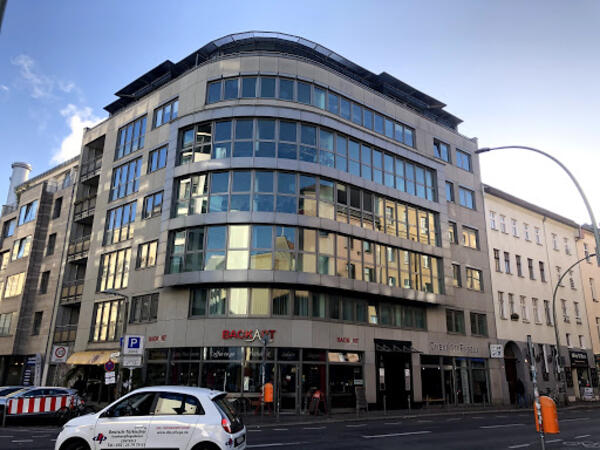
Our training facilities are located at Brückenstr. 4 in Berlin. Located on the fourth floor of a well-kept office building, our premises offer enough space for successful training courses in the heart of Berlin, within walking distance of the Jannowitzbrücke station.
Directions
The NobleProg training facilities are located in the heart of Berlin's Mitte district, just one underground station from Alexanderplatz, one of the centres of this vibrant city. By public transport you can reach us either by underground line U8 to Jannowitzbrücke station, followed by about 100 meters on foot.
Parking
Cars can be parked in the area along Brückenstr. and the nearby side streets, even if you may have to search for a moment. There is no charge for parking.
Local Amenities
Around the Rosenthaler Platz there are numerous small restaurants and shops where you can eat well and cheaply. There are also some hotels close by if you need accommodation for the training.
Our training facilities are located at Dianastrasse 46 in Potsdam-Babelsberg.
Our spacious training rooms are located directly opposite the Filmstudios Babelsberg and offer optimal training conditions for your needs.
Arrival
The NobleProg training facilities are conveniently located near the Medienstadt Babelsberg railway station,
and the A115 motorway is also easily accessible.
Parking
Parking is available in the surrounding streets around our training rooms.
Local Services
Potsdam offers numerous hotels and restaurants and is easily accessible thanks to its well-developed public transport system.
This live, instructor-led session (available online or onsite) is designed for intermediate-level developers, data scientists, and AI professionals aiming to utilize TensorFlow Lite for Edge AI solutions.
Upon completion, participants will be equipped to:
Comprehend the essentials of TensorFlow Lite and its significance in Edge AI.
Construct and optimize AI models through the use of TensorFlow Lite.
Deploy TensorFlow Lite models onto various edge-based hardware.
Leverage specific tools and methods for model transformation and performance tuning.
Create and deploy practical Edge AI applications using TensorFlow Lite.
This instructor-led, live training in Berlin (online or onsite) is aimed at advanced-level professionals who wish to deepen their understanding of computer vision and explore TensorFlow's capabilities for developing sophisticated vision models using Google Colab.
By the end of this training, participants will be able to:
Build and train convolutional neural networks (CNNs) using TensorFlow.
Leverage Google Colab for scalable and efficient cloud-based model development.
Implement image preprocessing techniques for computer vision tasks.
Deploy computer vision models for real-world applications.
Use transfer learning to enhance the performance of CNN models.
Visualize and interpret the results of image classification models.
This instructor-led live training conducted in Berlin (either online or on-site) is designed for intermediate-level data scientists and developers seeking to master deep learning techniques within the Google Colab environment.
By the conclusion of this program, participants will have the ability to:
Establish and navigate Google Colab for deep learning projects.
Comprehend the fundamental mechanics of neural networks.
Build deep learning models utilizing TensorFlow.
Train and assess deep learning model performance.
Apply advanced TensorFlow features to deep learning workflows.
This live, instructor-led training in Berlin (offered online or on-site) is intended for advanced-level professionals aiming to master cutting-edge deep learning techniques for NLU.
By the conclusion of this training, participants will be capable of:
Distinguishing the key disparities between NLU and standard NLP models.
Applying advanced deep learning methods to NLU challenges.
Examining deep architectures such as transformers and attention mechanisms.
Leveraging future NLU developments to engineer advanced AI systems.
This instructor-led, live training in Berlin (delivered online or on-site) is tailored for advanced professionals aiming to explore state-of-the-art XAI techniques for deep learning models, prioritizing the creation of interpretable AI systems.
Upon completion, participants will possess the ability to:
Comprehend the complexities of explainability within deep learning.
Execute advanced XAI techniques applicable to neural networks.
Interpret the outputs and decisions generated by deep learning models.
Weigh the trade-offs inherent in balancing performance with transparency.
This instructor-led, live training in Berlin, available online or onsite, targets intermediate to advanced-level data scientists, machine learning engineers, deep learning researchers, and computer vision experts looking to advance their proficiency in deep learning for text-to-image generation.
By the conclusion of this program, participants will be capable of:
Understanding advanced deep learning architectures and techniques for text-to-image generation.
Implementing complex models and optimizations for high-quality image synthesis.
Optimizing performance and scalability for large datasets and complex models.
Tuning hyperparameters to enhance model performance and generalization.
Integrating Stable Diffusion with other deep learning frameworks and tools
This live, instructor-led program in Berlin (delivered online or onsite) targets advanced professionals seeking to apply AI techniques to transform drug discovery and development operations.
By the conclusion of this course, participants will be able to:
Grasp the significance of AI in the drug discovery and development pipeline.
Leverage machine learning to anticipate molecular traits and behaviors.
Employ deep learning models for virtual screening and refining lead candidates.
Incorporate AI-driven methods into clinical trial management.
This live, instructor-led training in Berlin (available online or on-site) is designed for biologists aiming to understand how AlphaFold functions and to utilize its models as a guide for their experimental studies.
By the conclusion of this training, participants will be able to:
Comprehend the core principles of AlphaFold.
Understand the workflow and mechanics of the system.
Interpret the predictions and results generated by AlphaFold.
This live, instructor-led training in Berlin (available online or onsite) is designed for developers from beginner to intermediate levels who aim to utilize Large Language Models for various natural language tasks.
By the conclusion of this training, participants will be able to:
Set up a development environment that incorporates a popular LLM.
Create a basic LLM and fine-tune it on a custom dataset.
Apply LLMs to different natural language tasks, including text summarization, question answering, text generation, and more.
Debug and evaluate LLMs using tools such as TensorBoard, PyTorch Lightning, and Hugging Face Datasets.
This instructor-led live training, available in both online and onsite formats, is curated for data scientists, machine learning engineers, and computer vision researchers who intend to leverage Stable Diffusion for generating high-fidelity images across multiple use cases.
By the conclusion of the training, participants will be equipped to:
Comprehend the operational principles and workflow of Stable Diffusion in image generation.
Develop and train Stable Diffusion models for specific image creation tasks.
Implement Stable Diffusion in various scenarios, including inpainting, outpainting, and image-to-image translation.
Enhance the performance metrics and stability of Stable Diffusion models.
In this instructor-led, live training conducted in Berlin, participants will master the most relevant and cutting-edge machine learning techniques in Python. The curriculum involves building a series of demonstration applications that process image, music, text, and financial data.
By the conclusion of this training, participants will be capable of:
Implementing machine learning algorithms and techniques to resolve complex issues.
Applying deep learning and semi-supervised learning to scenarios involving image, music, text, and financial data.
Maximizing the performance of Python algorithms.
Utilizing key libraries and packages, including NumPy and Theano.
This practical training in Berlin empowers programmers to develop AI models from scratch using Python. You will gain proficiency in supervised learning, neural networks, and unsupervised techniques by utilizing scikit-learn and Apache Spark. The program emphasizes hands-on Jupyter exercises to address real-world challenges effectively.
This instructor-led course on Berlin delves into both the theoretical principles and hands-on implementation of Deep Reinforcement Learning using Python. Participants will learn to build and train DRL agents with TensorFlow or PyTorch, utilizing key algorithms like DQN and PPO to address complex, real-world challenges.
An introductory training on Berlin that explores AI fundamentals, ranging from intelligent agents to machine learning. It empowers executives and architects to evaluate emerging AI trends, integrate practical solutions, and boost business agility through automated strategies.
Discover the transformative impact of Machine Learning and Deep Learning on the automotive sector. This Berlin course delves into core concepts, spanning from simple automation to autonomous decision-making, and features neural networks alongside practical TensorFlow examples for real-world applications.
This comprehensive three-day program in Berlin examines both the theoretical and practical aspects of Artificial Neural Networks, Machine Learning, and Deep Learning. Attendees will investigate network architectures, learning mechanisms, and underlying mathematical principles, progressing from foundational perceptrons to sophisticated deep learning methodologies.
This live, instructor-led training in Berlin (available online or onsite) offers an introductory perspective on pattern recognition and machine learning. It covers practical applications within statistics, computer science, signal processing, computer vision, data mining, and bioinformatics.
By the end of the course, participants will have the ability to:
Apply core statistical methods to pattern recognition.
Leverage key models like neural networks and kernel methods for data analysis.
Implement advanced techniques for complex problem-solving.
Improve prediction accuracy by integrating various models.
This live, instructor-led training in Berlin—delivered online or on-site—is designed for software developers, data analysts, and technical professionals who intend to utilize TensorFlow 2.x and Keras to build, train, and deploy deep learning models for computer vision, natural language processing, and multimodal applications.
This live, instructor-led training program, conducted at Berlin (either online or on-site), is tailored for data scientists seeking to utilize TensorFlow for the analysis of potential fraud data.
By the conclusion of this training, participants will have the capability to:
Build a fraud detection model utilizing Python and TensorFlow.
Develop linear regression and associated models to predict fraud.
Create a complete, end-to-end AI application for analyzing fraud data.
In this instructor-led live training, participants will discover how to utilize MATLAB to design, build, and visualize convolutional neural networks for image recognition.
By the conclusion of this training, participants will be equipped to:
Develop a deep learning model
Automate the labeling of data
Utilize models from Caffe and TensorFlow-Keras
Train data utilizing multiple GPUs, cloud services, or cluster infrastructures
Audience
Developers
Engineers
Domain Experts
Course Format
A mix of lectures, discussions, exercises, and intensive hands-on practice
This live, instructor-led session in Berlin (accessible online or onsite) is designed for developers and data scientists aiming to utilize TensorFlow 2.x to develop predictors, classifiers, generative models, neural networks, and related systems.
By the conclusion of this training, participants will be capable of:
Setting up and configuring the TensorFlow 2.x environment.
Understanding the improvements TensorFlow 2.x brings compared to prior versions.
This 35-hour course in Berlin delves into the fundamentals of deep neural networks, covering CNNs, RNNs, and generative models such as GANs. Participants will gain practical experience with Theano and TensorFlow, learning how to build, train, and deploy production-grade deep learning models for real-world applications.
Read more...
Last Updated:
Testimonials (5)
Getting people that never used AI some repetition in prompting and people that do use AI to consider different methods to using it.
Matthew Gay - Tarsus Pharmaceuticals
Course - Artificial Intelligence (AI) Overview
The training was organized and well-planned out, and I come out of it with systematized knowledge and a good look at topics we looked at
Magdalena - Samsung Electronics Polska Sp. z o.o.
Course - Deep Learning with TensorFlow 2
Working from first principles in a focused way, and moving to applying case studies within the same day
Maggie Webb - Department of Jobs, Regions, and Precincts
Course - Artificial Neural Networks, Machine Learning, Deep Thinking
That it was applying real company data.
Trainer had a very good approach by making trainees participate and compete
Jimena Esquivel - Zaklad Uslugowy Hakoman Andrzej Cybulski
Course - Applied AI from Scratch in Python
In-depth coverage of machine learning topics, particularly neural networks. Demystified a lot of the topic.
Online Deep Learning (DL) training in Berlin, Deep Learning training courses in Berlin, Weekend DL (Deep Learning) courses in Berlin, Evening Deep Learning (DL) training in Berlin, DL (Deep Learning) instructor-led in Berlin, Deep Learning one on one training in Berlin, Deep Learning classes in Berlin, Deep Learning instructor in Berlin, DL (Deep Learning) coaching in Berlin, Deep Learning (DL) trainer in Berlin, Deep Learning (DL) boot camp in Berlin, Deep Learning (DL) instructor-led in Berlin, Online Deep Learning (DL) training in Berlin, Deep Learning (DL) private courses in Berlin, Evening Deep Learning (DL) courses in Berlin, Deep Learning on-site in Berlin, Weekend Deep Learning training in Berlin