NobleProg delivers high-quality Machine Learning training courses in Berlin, the dynamic heart of Germany's tech and innovation sector. Participants benefit from expert-led instruction tailored to the professional needs of the capital's diverse industry landscape. Join our Berlin-based programs to enhance your skills with hands-on learning experiences in a world-class urban environment.
Whether delivered online or onsite, these instructor-led Machine Learning (ML) training courses emphasize hands-on practice, demonstrating how to utilize machine learning techniques and tools to solve real-world challenges across various industries. NobleProg’s ML curriculum covers a range of programming languages and frameworks, such as Python, R language, and Matlab. The courses address diverse industry applications, including Finance, Banking, and Insurance, while covering both the fundamentals of Machine Learning and advanced methodologies like Deep Learning.
Machine Learning training is offered as either "online live training" or "onsite live training". Online live training (also known as "remote live training") is conducted through an interactive remote desktop connection. Onsite live training can take place directly at customer premises in Berlin or at NobleProg’s corporate training centers located in Berlin.
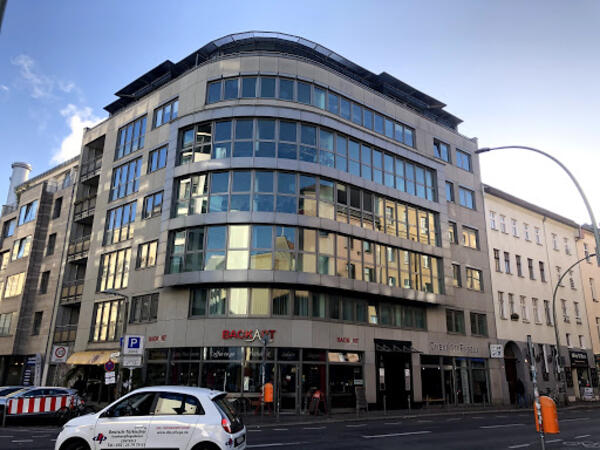
Our training facilities are located at Brückenstr. 4 in Berlin. Located on the fourth floor of a well-kept office building, our premises offer enough space for successful training courses in the heart of Berlin, within walking distance of the Jannowitzbrücke station.
Directions
The NobleProg training facilities are located in the heart of Berlin's Mitte district, just one underground station from Alexanderplatz, one of the centres of this vibrant city. By public transport you can reach us either by underground line U8 to Jannowitzbrücke station, followed by about 100 meters on foot.
Parking
Cars can be parked in the area along Brückenstr. and the nearby side streets, even if you may have to search for a moment. There is no charge for parking.
Local Amenities
Around the Rosenthaler Platz there are numerous small restaurants and shops where you can eat well and cheaply. There are also some hotels close by if you need accommodation for the training.
Our training facilities are located at Dianastrasse 46 in Potsdam-Babelsberg.
Our spacious training rooms are located directly opposite the Filmstudios Babelsberg and offer optimal training conditions for your needs.
Arrival
The NobleProg training facilities are conveniently located near the Medienstadt Babelsberg railway station,
and the A115 motorway is also easily accessible.
Parking
Parking is available in the surrounding streets around our training rooms.
Local Services
Potsdam offers numerous hotels and restaurants and is easily accessible thanks to its well-developed public transport system.
This instructor-led, live training session, conducted Berlin (online or onsite), is designed for beginner-level professionals looking to understand pre-trained models and learn how to deploy them to solve practical problems without developing models from scratch.
By the conclusion of this training, participants will be equipped to:
Grasp the concept and benefits of pre-trained models.
Examine different pre-trained model architectures and their applicable use cases.
Fine-tune pre-trained models to suit specific tasks.
Deploy pre-trained models in simple machine learning projects.
This live, instructor-led training program in Berlin (available online or on-site) is designed for participants of all skill levels who intend to use Google's AutoML platform to build customized chatbots for diverse use cases.
By the conclusion of the training, participants will be capable of:
Comprehending the essentials of chatbot development.
Accessing the Google Cloud Platform and utilizing AutoML effectively.
Preparing data necessary for training chatbot models.
Training and evaluating custom chatbot models via AutoML.
Deploying and integrating chatbots into various platforms and channels.
Monitoring chatbot performance and implementing optimizations over time.
This instructor-led, live training in Berlin (available online or in-person) is designed for intermediate-level AI developers, machine learning engineers, and system architects aiming to optimize their AI models for edge deployment.
By the conclusion of the training, participants will have the capability to:
Comprehend the obstacles and specific requirements associated with edge device deployment.
Apply model compression techniques to effectively reduce model size and complexity.
Utilize quantization approaches to improve efficiency on edge hardware.
Execute pruning and additional optimization tactics to enhance model performance.
Deploy refined AI models onto diverse edge device platforms.
This live, instructor-led training in Berlin, available online or onsite, is designed for intermediate developers, data scientists, and tech enthusiasts aiming to acquire practical expertise in deploying AI models on edge devices for diverse applications.
By the conclusion of this training, participants will be able to:
Comprehend the foundational principles of Edge AI and its associated benefits.
Establish and configure a functional edge computing environment.
Develop, train, and optimize AI models for specific edge deployment scenarios.
Implement practical AI solutions directly on edge devices.
Evaluate and enhance the performance of models deployed on the edge.
Address ethical and security implications within Edge AI applications.
This live, instructor-led training, held in Berlin (online or onsite), targets advanced AI engineers and data scientists with intermediate-to-advanced experience. The focus is on improving DeepSeek model performance, lowering latency, and efficiently deploying AI solutions via modern MLOps practices.
By the end of the program, participants will be equipped to:
Optimize DeepSeek models for efficiency, accuracy, and scalability.
Implement best practices for MLOps and model versioning.
Deploy DeepSeek models on cloud and on-premise infrastructure.
Monitor, maintain, and scale AI solutions effectively.
This live training in Berlin empowers intermediate practitioners to develop automated MLOps pipelines on Kubernetes. Participants will learn to design CI/CD workflows, apply GitOps strategies, and deploy ML models using containerized infrastructure, ensuring scalable and reproducible machine learning operations.
This practical training in Berlin provides the necessary expertise to build, train, and deploy machine learning models on Kubernetes via Kubeflow. Participants will master navigating the ecosystem, developing scalable pipelines, and overseeing production-grade workloads using industry best practices.
This instructor-led program in Berlin empowers advanced professionals to architect, optimize, and deploy robust TinyML pipelines. Through practical laboratory work, participants will master data collection, low-power model training, and the testing of real-world applications.
This live, instructor-led session (available online or onsite) is designed for intermediate-level developers, data scientists, and AI professionals aiming to utilize TensorFlow Lite for Edge AI solutions.
Upon completion, participants will be equipped to:
Comprehend the essentials of TensorFlow Lite and its significance in Edge AI.
Construct and optimize AI models through the use of TensorFlow Lite.
Deploy TensorFlow Lite models onto various edge-based hardware.
Leverage specific tools and methods for model transformation and performance tuning.
Create and deploy practical Edge AI applications using TensorFlow Lite.
This professional development session, available online or in person in Berlin, is specifically tailored for advanced experts looking to deepen their mastery of autonomous system technologies.
By the conclusion of the program, attendees will be equipped to:
Create and deploy AI models that enable autonomous decision-making.
Build control algorithms for precise autonomous navigation and obstacle avoidance.
Uphold safety standards and reliability metrics in AI-integrated autonomous systems.
Integrate autonomous functionalities into existing robotics and AI ecosystems.
This instructor-led, live training in Berlin (online or onsite) is aimed at advanced-level professionals who wish to deepen their understanding of computer vision and explore TensorFlow's capabilities for developing sophisticated vision models using Google Colab.
By the end of this training, participants will be able to:
Build and train convolutional neural networks (CNNs) using TensorFlow.
Leverage Google Colab for scalable and efficient cloud-based model development.
Implement image preprocessing techniques for computer vision tasks.
Deploy computer vision models for real-world applications.
Use transfer learning to enhance the performance of CNN models.
Visualize and interpret the results of image classification models.
This instructor-led training in Berlin empowers advanced professionals to secure TinyML pipelines on edge devices. It guides you in implementing privacy-preserving strategies, fortifying models against adversarial attacks, and applying secure data handling practices in constrained environments.
This live, instructor-led training in Berlin (online or on-site) is tailored for advanced professionals looking to expand their knowledge of machine learning models, sharpen their hyperparameter tuning skills, and learn to deploy models efficiently using Google Colab.
By the conclusion of this training, participants will be capable of:
Building advanced machine learning models using leading frameworks like Scikit-learn and TensorFlow.
Improving model performance through hyperparameter tuning.
Deploying machine learning models in real-world applications via Google Colab.
Collaborating on and managing large-scale machine learning projects in Google Colab.
Aimed at intermediate-level professionals, this live, instructor-led training in Berlin (delivered online or onsite) teaches how to apply AI techniques to optimize yield management in semiconductor manufacturing.
By the end of this program, participants will be able to:
Interpret production data to determine the factors driving yield rates.
Utilize AI algorithms to improve the efficiency of yield management processes.
Adjust production parameters to lower defect rates and enhance overall yields.
Incorporate AI-based yield management into current production workflows.
This instructor-led, live training in Berlin (online or onsite) is designed for intermediate-level business and AI professionals seeking to apply machine learning in business contexts, forecasting, and AI-driven systems, using real case studies and Python-based tools.
By the end of this training, participants will have the ability to:
Understand the integration of machine learning within AI and business strategy.
Apply supervised and unsupervised learning techniques to structured business challenges.
Preprocess and transform data for modeling purposes.
Use neural networks for classification and prediction tasks.
Conduct sales forecasting using statistical and ML-based methods.
Implement clustering and association rule mining for customer segmentation and pattern discovery.
This live, instructor-led training in Berlin (online or onsite) is tailored for intermediate-level professionals aiming to utilize AI-driven predictive maintenance techniques in semiconductor manufacturing to improve production efficiency and prevent unforeseen equipment failures.
By the conclusion of this training, participants will be capable of:
Deploying AI models to predict equipment failures in semiconductor manufacturing.
Analyzing maintenance data to spot patterns and trends that indicate potential issues.
Integrating AI-based predictive maintenance into established manufacturing workflows.
Minimizing downtime and maintenance expenses through proactive equipment oversight.
This instructor-led, live training in Berlin (available online or in-person) is tailored for advanced professionals aiming to apply leading-edge AI methods to semiconductor design automation, thereby improving efficiency, precision, and innovation in chip design and verification.
By the conclusion of this program, participants will be able to:
Deploy advanced AI techniques to streamline and optimize semiconductor design operations.
Integrate machine learning models into EDA tools to enhance design validation.
Formulate AI-driven solutions to address complex design issues in chip fabrication.
Harness neural networks to boost the precision and speed of design automation.
This instructor-led live training conducted in Berlin (either online or on-site) is designed for intermediate-level data scientists and developers seeking to master deep learning techniques within the Google Colab environment.
By the conclusion of this program, participants will have the ability to:
Establish and navigate Google Colab for deep learning projects.
Comprehend the fundamental mechanics of neural networks.
Build deep learning models utilizing TensorFlow.
Train and assess deep learning model performance.
Apply advanced TensorFlow features to deep learning workflows.
This live, instructor-led training in Berlin (delivered online or on-site) is tailored for intermediate professionals seeking to master AI techniques for enhancing semiconductor fabrication efficiency.
By the conclusion of the program, participants will be equipped to:
Comprehend AI methodologies for optimizing chip fabrication processes.
Apply AI models to increase yield and decrease defect rates.
Scrutinize process data to determine essential optimization parameters.
Leverage machine learning to fine-tune semiconductor production lines.
This live, instructor-led session in Berlin (online or on-site) is tailored for intermediate-level individuals seeking to automate and oversee machine learning processes, including training, validation, and deploying models with Apache Airflow.
By the conclusion of the program, participants will be equipped to:
Establish Apache Airflow for the orchestration of machine learning workflows.
Automate tasks related to data preparation, model training, and validation.
Integrate Airflow with diverse machine learning frameworks and tools.
Deploy machine learning models via automated pipelines.
Monitor and refine machine learning workflows in production.
This instructor-led live training in Berlin (delivered online or onsite) is designed for intermediate data scientists and developers seeking to efficiently apply machine learning algorithms within the Google Colab environment.
Upon completing this training, participants will have the capability to:
Set up and navigate Google Colab for machine learning projects.
Understand and apply various machine learning algorithms.
Use libraries like Scikit-learn to analyze and predict data.
Implement supervised and unsupervised learning models.
Optimize and evaluate machine learning models effectively.
This instructor-led, live training in Berlin empowers advanced practitioners to fine-tune TinyML models for embedded devices with limited resources. Participants will master quantization and pruning, build low-latency inference pipelines, and evaluate performance against memory and energy constraints.
This instructor-led, live training in Berlin (delivered online or on-site) is tailored for advanced professionals aiming to explore state-of-the-art XAI techniques for deep learning models, prioritizing the creation of interpretable AI systems.
Upon completion, participants will possess the ability to:
Comprehend the complexities of explainability within deep learning.
Execute advanced XAI techniques applicable to neural networks.
Interpret the outputs and decisions generated by deep learning models.
Weigh the trade-offs inherent in balancing performance with transparency.
Designed for entry-level experts seeking to grasp and deploy AI solutions within the semiconductor sector, this live, instructor-guided program is available both online and on-site in Berlin.
Upon completion, attendees will be equipped to:
Grasp the core tenets of AI and their specific application in semiconductor fabrication.
Pinpoint specific sectors within semiconductor production where AI integration yields significant results.
Leverage AI-driven instruments and methodologies to boost productivity and precision in quality control.
Deploy foundational AI models to streamline and optimize manufacturing operations.
This instructor-led training in Berlin walks professionals through the process of containerizing entire ML pipelines with Docker. Learners will master creating reproducible environments, orchestrating training and inference workloads, and implementing CI/CD for scalable MLOps deployments.
This live, instructor-led training in Berlin (available online or onsite) targets data scientists and developers aiming to utilize ML.NET machine learning models. The goal is to automatically derive projections from data analyses to support enterprise applications.
By the end of this training, participants will be able to:
Install ML.NET and integrate it into the application development environment.
Comprehend the machine learning principles behind ML.NET tools and algorithms.
Build and train machine learning models to perform intelligent predictions using provided data.
Evaluate the performance of machine learning models using ML.NET metrics.
Optimize the accuracy of existing machine learning models within the ML.NET framework.
Apply ML.NET machine learning concepts to other data science applications.
This instructor-led live training, available Berlin (online or onsite), is designed for intermediate-level data professionals looking to apply machine learning methodologies to data-driven business issues. Topics include sales forecasting and predictive modeling utilizing neural networks.
By the conclusion of the program, participants will be equipped to:
Comprehend the foundational concepts and various types of machine learning.
Implement key algorithms for classification, regression, clustering, and association analysis.
Execute exploratory data analysis and data preparation tasks using Python.
Utilize neural networks for complex nonlinear modeling tasks.
Apply predictive analytics for business forecasting, particularly with sales data.
Assess and optimize model performance using visual and statistical approaches.
This instructor-led, live training in Berlin, available online or onsite, targets intermediate to advanced-level data scientists, machine learning engineers, deep learning researchers, and computer vision experts looking to advance their proficiency in deep learning for text-to-image generation.
By the conclusion of this program, participants will be capable of:
Understanding advanced deep learning architectures and techniques for text-to-image generation.
Implementing complex models and optimizations for high-quality image synthesis.
Optimizing performance and scalability for large datasets and complex models.
Tuning hyperparameters to enhance model performance and generalization.
Integrating Stable Diffusion with other deep learning frameworks and tools
This instructor-led live session in Berlin (online or on-site) is tailored for intermediate to advanced cybersecurity experts looking to refine their proficiency in AI-assisted threat identification and incident handling.
Upon completion, attendees will be equipped to:
Deploy sophisticated AI algorithms for instant threat identification.
Adapt AI models to address specific cybersecurity challenges.
Construct automated workflows for managing threat responses.
Protect AI-based security instruments from adversarial exploits.
This instructor-led, live training in Berlin (online or onsite) is tailored for intermediate-level embedded systems engineers and AI developers looking to deploy machine learning models on microcontrollers using TensorFlow Lite and Edge Impulse.
By the conclusion of this session, participants will be capable of:
Comprehending the essentials of TinyML and its value proposition for edge AI.
Establishing a dedicated development workspace for TinyML tasks.
Training, optimizing, and deploying AI models on energy-efficient microcontrollers.
Utilizing TensorFlow Lite and Edge Impulse to create real-world TinyML solutions.
Enhancing model performance regarding power consumption and memory footprint.
This live, instructor-led training session, conducted in Berlin (either online or on-site), is tailored for junior cybersecurity professionals aiming to master the use of AI for enhanced threat detection and response mechanisms.
By the conclusion of this course, participants will have the ability to:
Grasp the diverse applications of AI in the field of cybersecurity.
Apply AI algorithms effectively for threat identification.
Automate incident response workflows using AI-driven tools.
Integrate AI solutions into established cybersecurity infrastructures.
This live, instructor-led training in Berlin (available online or on-site) is designed for biologists aiming to understand how AlphaFold functions and to utilize its models as a guide for their experimental studies.
By the conclusion of this training, participants will be able to:
Comprehend the core principles of AlphaFold.
Understand the workflow and mechanics of the system.
Interpret the predictions and results generated by AlphaFold.
This instructor-led live training in Berlin (online or on-site) is tailored for intermediate-level data analysts seeking to learn how to employ RapidMiner for value estimation and forecasting, and to utilize analytical tools for time series predictions.
By the conclusion of this program, participants will be able to:
Implement the CRISP-DM methodology, select appropriate machine learning algorithms, and enhance model building and performance.
Utilize RapidMiner to estimate and forecast values, and apply analytical tools for time series forecasting.
This instructor-led live training, available in both online and onsite formats, is curated for data scientists, machine learning engineers, and computer vision researchers who intend to leverage Stable Diffusion for generating high-fidelity images across multiple use cases.
By the conclusion of the training, participants will be equipped to:
Comprehend the operational principles and workflow of Stable Diffusion in image generation.
Develop and train Stable Diffusion models for specific image creation tasks.
Implement Stable Diffusion in various scenarios, including inpainting, outpainting, and image-to-image translation.
Enhance the performance metrics and stability of Stable Diffusion models.
Gain hands-on experience in applying Machine Learning techniques using Python at this Berlin training. The curriculum explores fundamental algorithms such as regression, classification, and clustering, guiding you through making strategic modeling decisions, interpreting outcomes, and validating results via practical, real-world case studies.
This practical training in Berlin empowers programmers to develop AI models from scratch using Python. You will gain proficiency in supervised learning, neural networks, and unsupervised techniques by utilizing scikit-learn and Apache Spark. The program emphasizes hands-on Jupyter exercises to address real-world challenges effectively.
This instructor-led course on Berlin delves into both the theoretical principles and hands-on implementation of Deep Reinforcement Learning using Python. Participants will learn to build and train DRL agents with TensorFlow or PyTorch, utilizing key algorithms like DQN and PPO to address complex, real-world challenges.
An introductory training on Berlin that explores AI fundamentals, ranging from intelligent agents to machine learning. It empowers executives and architects to evaluate emerging AI trends, integrate practical solutions, and boost business agility through automated strategies.
Discover the transformative impact of Machine Learning and Deep Learning on the automotive sector. This Berlin course delves into core concepts, spanning from simple automation to autonomous decision-making, and features neural networks alongside practical TensorFlow examples for real-world applications.
This intensive 8-day course charts a comprehensive path from solid Python engineering principles to the design of sophisticated AI systems. Learners will cultivate disciplined coding habits, gain mastery over statistical and deep learning techniques, and construct robust generative AI and agent-based solutions ready for production. The curriculum prioritizes reliability, rigorous evaluation, safety protocols, and practical deployment strategies over mere experimentation.
This comprehensive three-day program in Berlin examines both the theoretical and practical aspects of Artificial Neural Networks, Machine Learning, and Deep Learning. Attendees will investigate network architectures, learning mechanisms, and underlying mathematical principles, progressing from foundational perceptrons to sophisticated deep learning methodologies.
Develop practical skills in model evaluation, bias-variance trade-offs, and deep learning to create robust predictive solutions by mastering Machine Learning algorithms such as Naive Bayes, Decision Trees, Neural Networks, SVMs, and Clustering in this hands-on Berlin course.
This live, instructor-led training in Berlin (available online or onsite) offers an introductory perspective on pattern recognition and machine learning. It covers practical applications within statistics, computer science, signal processing, computer vision, data mining, and bioinformatics.
By the end of the course, participants will have the ability to:
Apply core statistical methods to pattern recognition.
Leverage key models like neural networks and kernel methods for data analysis.
Implement advanced techniques for complex problem-solving.
Improve prediction accuracy by integrating various models.
This live, instructor-led training program, conducted at Berlin (either online or on-site), is tailored for data scientists seeking to utilize TensorFlow for the analysis of potential fraud data.
By the conclusion of this training, participants will have the capability to:
Build a fraud detection model utilizing Python and TensorFlow.
Develop linear regression and associated models to predict fraud.
Create a complete, end-to-end AI application for analyzing fraud data.
This instructor-led live training in Berlin provides a comprehensive overview of AI, machine learning, and deep learning fundamentals. Participants will leverage Python, Keras, and TensorFlow to construct practical telecom models, such as credit risk and churn prediction tools, thereby acquiring hands-on skills for real-world data science applications.
This hands-on, instructor-led program serves as a direct progression from the Python for Data Analysis curriculum.
Participants will be introduced to the fundamental concepts of Machine Learning and will learn to apply these techniques directly to analytical challenges, including prediction, classification, and segmentation.
The course emphasizes practical understanding, leveraging familiar tools such as Python, Pandas, and Jupyter Notebook, and does not require an advanced mathematical foundation.
This instructor-led, live training in Berlin (offered online or onsite) is designed for developers and data scientists aiming to build, deploy, and manage machine learning workflows on Kubernetes.
By the conclusion of this training, participants will be able to:
Install and configure Kubeflow in both on-premise and cloud environments.
Construct, deploy, and manage ML workflows utilizing Docker containers and Kubernetes.
Execute complete machine learning pipelines across diverse architectures and cloud platforms.
Leverage Kubeflow to create and manage Jupyter notebooks.
Develop ML training, hyperparameter tuning, and serving workloads across multiple platforms.
This instructor-led live training in Berlin (online or onsite) is designed for engineers seeking to evaluate current approaches and tools. This empowers them to make intelligent decisions about adopting MLOps within their organization.
By the end of this training, participants will be able to:
Install and configure various MLOps frameworks and tools.
Assemble the appropriate team with the right skills to construct and support an MLOps system.
Prepare, validate, and version data for use by ML models.
Understand the components of an ML Pipeline and the tools needed to build one.
Experiment with different machine learning frameworks and servers for deploying to production.
Operationalize the entire Machine Learning process to ensure it is reproducible and maintainable.
This professionally led, live training session in Berlin (available online or on-site) is designed for intermediate-level data analysts, developers, or aspiring data scientists looking to apply machine learning techniques in Python. The focus is on extracting insights, generating predictions, and automating data-driven decisions.
By the conclusion of this course, participants will be able to:
Understand and differentiate between key machine learning paradigms.
Explore data preprocessing techniques and model evaluation metrics.
Apply machine learning algorithms to solve real-world data problems.
Use Python libraries and Jupyter notebooks for hands-on development.
Build models for prediction, classification, recommendation, and clustering.
This live, instructor-led session in Berlin (accessible online or onsite) is designed for developers and data scientists aiming to utilize TensorFlow 2.x to develop predictors, classifiers, generative models, neural networks, and related systems.
By the conclusion of this training, participants will be capable of:
Setting up and configuring the TensorFlow 2.x environment.
Understanding the improvements TensorFlow 2.x brings compared to prior versions.
This 35-hour course in Berlin delves into the fundamentals of deep neural networks, covering CNNs, RNNs, and generative models such as GANs. Participants will gain practical experience with Theano and TensorFlow, learning how to build, train, and deploy production-grade deep learning models for real-world applications.
I thoroughly enjoyed the training and appreciated the deeper dive into the subject of Machine Learning. I appreciated the balance between theory and practical applications, especially the hands-on coding sessions. The trainer provided engaging examples and well-designed exercises that enhanced the learning experience. The course covered a wide range of topics, and Abhi demonstrated excellent expertise by answering all questions with clarity and ease.
Valentina
Course - Machine Learning
The training provided an interesting overview of deep learning models and related methods. The topic was quite new to me, but now I feel like I actually have an idea of what AI and ML can involve, what these terms consist of and how they can be used advantageously. In general, I liked the approach of starting with the statistical background and the basic learning models, such as linear regression, especially emphasizing the exercises in between.
Konstantin - REGNOLOGY ROMANIA S.R.L.
Course - Fundamentals of Artificial Intelligence (AI) and Machine Learning
Interesting knowledge
Gabriel - MINDEF
Course - Machine Learning with Python – 4 Days
Even with having to miss a day due to customer meetings, I feel I have a much clearer understanding of the processes and techniques used in Machine Learning and when I would use one approach over another. Our challenge now is to practice what we have learned and start to apply it to our problem domain
Online Machine Learning (ML) training in Berlin, Machine Learning training courses in Berlin, Weekend ML (Machine Learning) courses in Berlin, Evening Machine Learning (ML) training in Berlin, ML (Machine Learning) instructor-led in Berlin, Machine Learning (ML) private courses in Berlin, Machine Learning (ML) instructor-led in Berlin, Machine Learning instructor in Berlin, Machine Learning one on one training in Berlin, Weekend Machine Learning training in Berlin, ML (Machine Learning) coaching in Berlin, Machine Learning (ML) trainer in Berlin, Machine Learning classes in Berlin, Online Machine Learning (ML) training in Berlin, Machine Learning on-site in Berlin, Machine Learning (ML) boot camp in Berlin, Evening Machine Learning (ML) courses in Berlin