NobleProg delivers high-quality Software Design training courses in Berlin, the dynamic heart of Germany's tech and innovation sector. Participants benefit from expert-led instruction tailored to the professional needs of the capital's diverse industry landscape. Join our Berlin-based programs to enhance your skills with hands-on learning experiences in a world-class urban environment.
Conducted either online or onsite, these instructor-led Software Design training courses utilize interactive discussions and practical exercises to impart the core fundamentals of Software Design.
The Software Design curriculum is offered as either "online live training" or "onsite live training". Online live training (also referred to as "remote live training") is delivered through an interactive remote desktop session. Alternatively, onsite live training can be facilitated at your local premises in Berlin or within NobleProg's corporate training centers located in Berlin.
Our training facilities are located at Brückenstr. 4 in Berlin. Located on the fourth floor of a well-kept office building, our premises offer enough space for successful training courses in the heart of Berlin, within walking distance of the Jannowitzbrücke station.
Directions
The NobleProg training facilities are located in the heart of Berlin's Mitte district, just one underground station from Alexanderplatz, one of the centres of this vibrant city. By public transport you can reach us either by underground line U8 to Jannowitzbrücke station, followed by about 100 meters on foot.
Parking
Cars can be parked in the area along Brückenstr. and the nearby side streets, even if you may have to search for a moment. There is no charge for parking.
Local Amenities
Around the Rosenthaler Platz there are numerous small restaurants and shops where you can eat well and cheaply. There are also some hotels close by if you need accommodation for the training.
Our training facilities are located at Dianastrasse 46 in Potsdam-Babelsberg.
Our spacious training rooms are located directly opposite the Filmstudios Babelsberg and offer optimal training conditions for your needs.
Arrival
The NobleProg training facilities are conveniently located near the Medienstadt Babelsberg railway station,
and the A115 motorway is also easily accessible.
Parking
Parking is available in the surrounding streets around our training rooms.
Local Services
Potsdam offers numerous hotels and restaurants and is easily accessible thanks to its well-developed public transport system.
In this Berlin course, teams apply Design Thinking to resolve issues through empathy, ideation, and prototyping. With a primary focus on the Empathize stage, you will link pain points to internal client needs, leveraging dynamic collaborative activities to turn insights into actionable outcomes.
This live training in Berlin guides teams and leaders through the Empathize and Define stages of Design Thinking. Participants will learn to master active listening, empathy mapping, and the 5 Whys technique to uncover root causes and craft clear, actionable problem statements for internal clients.
This live, instructor-led training in Berlin—whether online or onsite—is tailored for professionals at beginner to intermediate levels seeking to master and apply Design Thinking frameworks to spur innovation and enhance business outcomes.
By the conclusion of this course, learners will be capable of:
Understanding the core tenets of Design Thinking and its contribution to innovation.
Utilizing the five phases of Design Thinking to tackle challenges.
Employing ideation techniques and tools to encourage creativity.
Deploying Design Thinking strategies to refine processes and improve efficiency.
This live, instructor-led training in Berlin (available online or on-site) caters to beginner and intermediate-level participants looking to resolve everyday workplace challenges through gamification techniques.
By the conclusion of this program, participants will be able to:
Comprehend the foundational principles of Design Thinking and their practical application in problem-solving.
Apply gamification techniques to boost engagement and spark innovation.
Develop creative and actionable solutions for common workplace issues.
Collaborate effectively across teams to execute problem-solving strategies.
Leverage iterative processes to refine solutions through feedback and experimentation.
This instructor-led Berlin training empowers senior developers with advanced Domain-Driven Design capabilities. Participants will learn to apply strategic and tactical patterns, define precise bounded contexts, and seamlessly integrate DDD into Agile workflows to deliver robust, scalable, and maintainable software.
This live, instructor-led training in Berlin (online or on-site) is designed for intermediate-level developers, architects, and analysts seeking to adopt DDD concepts and practices in their software endeavors.
By the end of this training, participants will be able to:
Understand core DDD concepts, including bounded contexts and entities, and their practical application in software projects.
Apply strategic DDD to define domain models, identify subdomains, and set boundaries.
Implement tactical DDD using patterns such as CQRS, factories, and event sourcing.
Refactor and modernize legacy systems using effective DDD techniques.
Design and build architectures that are product, domain, and team-oriented.
Utilize data mesh to establish a domain-oriented data platform that supports data discovery and governance.
This instructor-led, live training in Berlin (online or onsite) is tailored for entry-level leaders and HR professionals looking to apply Design Thinking methodologies to drive innovation, improve problem-solving capabilities, and enhance team engagement.
By the end of this program, participants will be able to:
Equip participants with the tools and methodologies necessary to foster innovation and team engagement.
Develop skills in empathy mapping, ideation, and prototyping to address complex challenges.
Apply Design Thinking principles to leadership and HR scenarios.
Promote a culture of innovation within tech teams.
This instructor-led, live training is delivered in Berlin (either online or onsite) and is specifically crafted for intermediate Java developers looking to apply design patterns to strengthen software structure, maintainability, and scalability.
By the end of the course, participants will be able to:
Understand the strategic value and benefits of design patterns.
Apply Creational, Structural, and Behavioral patterns with precision in Java.
Enhance the reusability, scalability, and maintainability of their code.
Refactor existing codebases using established design patterns.
This live, instructor-led training in Berlin (available online or on-site) is designed for software and systems designers ranging from beginner to intermediate levels who aim to gain a comprehensive and structured understanding of Sparx Enterprise Architect.
By the end of the training, participants will be able to:
Confidently navigate and operate Sparx Enterprise Architect, having a clear understanding of its interface and toolset.
Represent various business structures, including organizational charts, processes, and systems, using a range of diagram types.
Deploy change tracking, version control, and team collaboration methods within Sparx EA.
Employ advanced features of Sparx EA, such as modeling with stereotypes, system customization, and automated task handling.
This 21-hour training in Berlin delves into key Kubernetes design patterns for microservices. Learners will acquire foundational, behavioral, structural, and configuration strategies to construct resilient, scalable, and cloud-native applications through practical live-lab exercises.
This instructor-led training in Berlin explores core and advanced principles of software architecture and design. Participants will engage in hands-on lab exercises, discussions, and group projects to build robust, scalable, and secure software solutions that address real-world enterprise challenges.
This live, instructor-led session on Berlin (delivered online or onsite) is designed for experienced C# professionals seeking to architect, build, and deploy secure, high-performance .NET applications. The scope covers the full journey from requirements analysis and domain modeling to the implementation of ASP.NET Core APIs, Entity Framework Core data access, performance optimization, and final deployment.
Master Domain Driven Design to synchronize software with business concepts. Explore strategic and tactical patterns, such as Ubiquitous Language and Bounded Contexts. This training in Berlin equips teams to handle complexity and develop flexible, maintainable software architectures.
This 14-hour Design Patterns course in Berlin focuses on reusing proven patterns to significantly reduce time spent on design and testing. You will learn to develop organization-specific patterns, assess potential cost savings, and systematize your design workflow using UML and Java examples.
In this instructor-led, live workshop training in Berlin (available online or onsite), participants will learn how to apply the five stages of Design Thinking to better understand the problems experienced by end-users of a product or service, then develop the best approach for resolving them.
By the end of this training, participants will be able to:
Use creative strategies to match customers' needs with technologically feasible solutions.
Formulate a strategy to increase customer value and enhance product and service offerings.
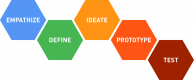
The Design Thinking (DT) methodology is structured around five distinct phases: empathize, define, ideate, prototype, and test.
In an era of growing complexity, traditional methods often fall short when addressing multifaceted challenges. Design Thinking provides a robust framework for tackling these intricate issues effectively. By mastering DT, organizations and individuals can enhance their ability to communicate persuasively, drive superior business outcomes, and elevate both personal and organizational performance.
Operational mechanics: This involves gaining insights from users and the problem itself, identifying underlying patterns, developing a model (while accounting for model drift), testing, evaluating, and refining the solution.
The interplay between Design Thinking, innovation strategies, and entrepreneurial endeavors.
Core methodologies and tools: Includes the creation of personas, stakeholder maps, and customer journey maps, as well as service blueprints and business model innovation.
Practical applications: Cultivating a design-centric mindset, driving disruptive innovation, adopting iterative and agile estimation techniques, and enhancing soft skills such as critical thinking, teamwork, leadership readiness, communication, emotional intelligence, cultural competency, and conflict resolution.
Objectives:
To gain a comprehensive understanding of the foundational principles and subtleties of DT.
To delve into the essential concepts, theories, types, and models within the Design Thinking framework.
To actively experiment with, experience, and apply DT principles in practice.
Delivery:
This intensive training program spans one day (4 hours) and is composed of the following elements:
Instructional sessions (40%): Focused on presenting theories, concepts, models, and facilitating interactive discussions.
Collaborative workshops (30%): Involving group dynamics, strategic games, discussions, and simulated conflict resolution scenarios.
Individual tasks (15%): Centered on writing, design exercises, and peer-to-peer analysis.
Supplementary resources (15%): Including video materials and curated reading assignments.
Note: Given the interactive nature of this course, a minimum group size of 3 participants is required.
This instructor-led live training in Berlin (online or onsite) is tailored for intermediate-level PHP developers aiming to apply design patterns effectively in their work.
By the end of the session, participants will have the ability to:
Understand the purpose and benefits of design patterns.
Identify and implement appropriate design patterns for common scenarios.
Structure PHP applications using industry-recognized best practices.
Integrate patterns into modern frameworks such as Symfony or Zend.
This live training on Berlin delves into the principles of embedded C design, assisting developers in mastering reliability, functionality, and logic. The program features hands-on exercises aimed at designing error-free applications, optimizing hardware performance, and understanding critical aspects such as system constraints, code reusability, and long-term maintainability.
This 14-hour advanced JavaScript course in Berlin is tailored for developers building complex web applications. It explores object-oriented programming, design patterns, and asynchronous communication strategies such as Promises and RxJS, emphasizing best practices to improve code architecture and reliability.
Geared towards experienced programmers, this 21-hour course in Berlin delves into design patterns and refactoring methodologies. Through practical sessions, learners will master GoF patterns, enterprise architecture, and essential tools to create efficient and maintainable PHP applications.
This comprehensive course in Berlin covers RISC-V architecture, assembly, Linux, FPGA, and AI applications. It addresses the global talent shortage by building expertise from ISA fundamentals to advanced SoC design. Ideal for engineers seeking to master modern, open-source computing stacks.
During this live training session hosted in Berlin, attendees will investigate the intricate relationship between software, technical, and enterprise architecture. The course focuses on managing complex distributed systems and their associated trade-offs, while providing mastery of standard patterns used in SOA, microservices, and efficient inter-system communication.
This course in Berlin is designed to ready developers and architects for the UML2 Intermediate exam. It delves into complex modeling, classification structures, and state machines. Participants will gain the proficiency to construct detailed UML models and secure their position as qualified senior members of UML development teams by mastering critical design components.
Read more...
Last Updated:
Testimonials (6)
Trainer knowledge, involvement, and rapport
Adam Kuklewski - GE Medical Systems Polska
Course - Technical Architecture and Patterns
complete, subject-focused, with multiple exercises and examples
Grzegorz Sposob - ASSECO POLAND S.A.
Course - OCUP2 UML Certification - Preparing for the UML2 Intermediate exam.
The explanations and interactivity of the trainer, he really brought the subject well; and even-though I was probably not experienced enough, I did learn a lot from it!
Pieter Bruynseels - Spot Buy Center BV
Course - Design Patterns
I liked the exercises that helped to open the mind and gain new insights into software architecture.
Gabriele - EAGLEPROJECTS S.p.A.
Course - Architecture and Design: Core + Advanced Training
I liked the platform we used. It was really nice and easy to use. I liked the typescript section, the part about namespaces and modules.
Online Software Design training in Berlin, Software Design training courses in Berlin, Weekend Software Design courses in Berlin, Evening Software Design training in Berlin, Software Design instructor-led in Berlin, Software Design coaching in Berlin, Software Design instructor-led in Berlin, Weekend Software Design training in Berlin, Software Design boot camp in Berlin, Software Design instructor in Berlin, Software Design private courses in Berlin, Online Software Design training in Berlin, Evening Software Design courses in Berlin, Software Design trainer in Berlin, Software Design on-site in Berlin, Software Design classes in Berlin, Software Design one on one training in Berlin